Rollover Messaging Centers for Medicare & Medicaid Services (CMS)
August 2025 through May 2026 (with pause for re-prioritization)OVERVIEW
Providing Medicare beneficiaries with details on upcoming plan changesThe Centers for Medicare & Medicaid Services (CMS) is the federal agency that provides health coverage to more than 160 million through Medicare, Medicaid, the Children's Health Insurance Program, and the Health Insurance Marketplace. The Medicare Coverage Tools (MCT) 2.0 program supports CMS in modernizing parts of the Medicare website, including the Medicare Plan Finder (MPF), cost data, support channels, and other coverage tools. MPF helps Medicare beneficiaries, their families and caregivers explore, compare, and enroll in Medicare plans.
PROJECT BACKGROUNDEvery year, ahead of Open Enrollment (OE), the Health Plan Management System (HPMS) team provided a 'Plan Crosswalk with Service Area' file to the Beneficiary Experience Data Analytics Platform (BEDAP). As an example, in 2024, this file contained the 2024 plans ('previous' plans) and the 2025 plans ('current' plans) that each plan is crosswalked to. When a Medicare plan is crosswalked, it means that enrollees in that plan are being automatically transitioned/rolled over or transferred to a different Medicare plan for the upcoming plan year. The process is designed so beneficiaries do not experience a gap in healthcare or prescription drug coverage. In certain scenarios, the beneficiary may also be disenrolled from their plan.
Each plan can fall into one of multiple rollover scenarios that determine what a beneficiary's upcoming plan year enrollment will be. In 2024, BEDAP completed an initiative to add rollover information to the data associated with a beneficiary. MCT has now transitioned to using this BEDAP data API to determine the rollover plan Medicare Plan Finder (MPF) will display to beneficiaries.
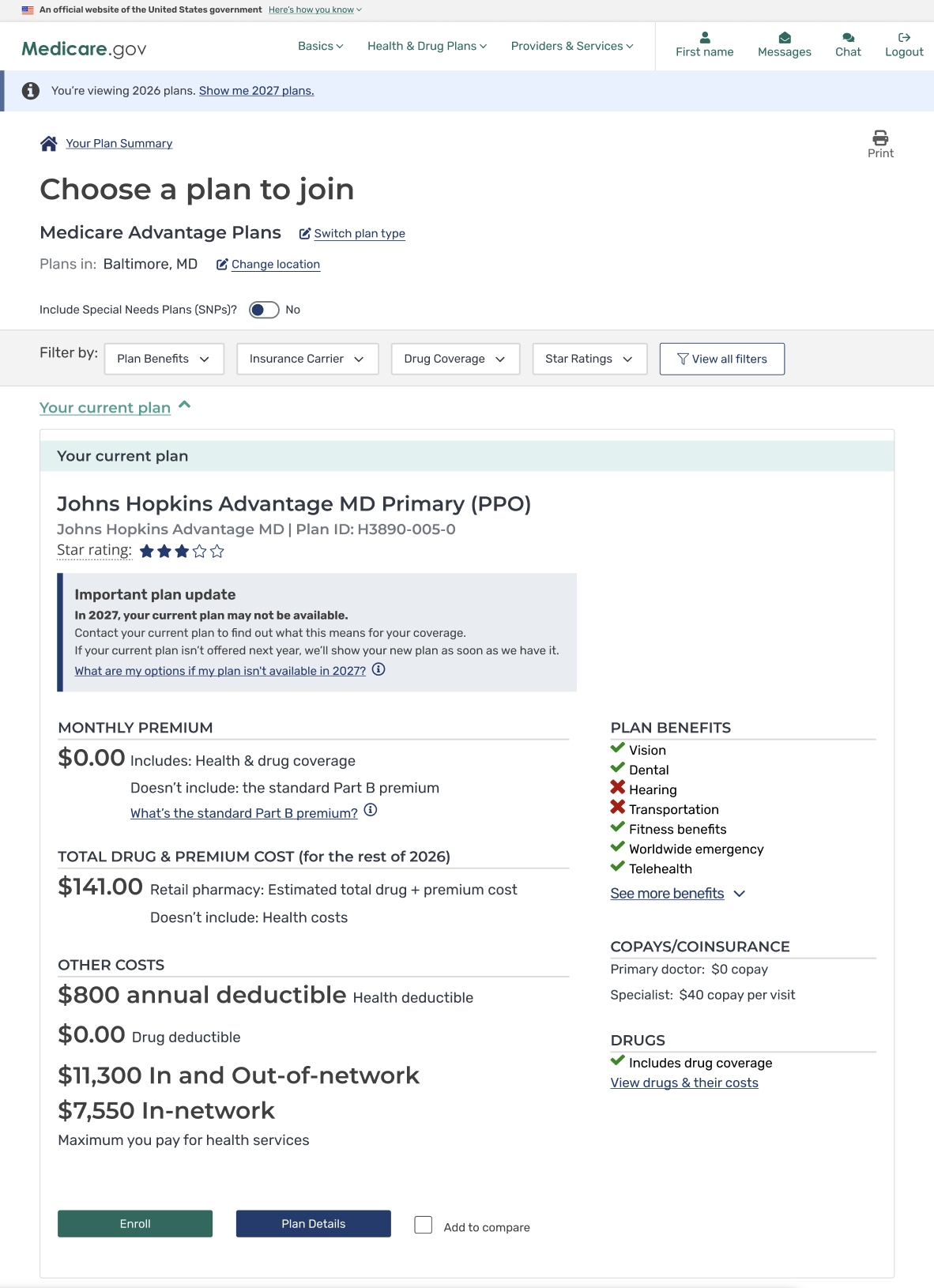
Ahead of the 2026 Open Enrollment (OE) period (October 15 through December 7, 2026), the Medicare Coverage Tools (MCT) team will launch the display of rollover messaging targeted at beneficiaries affected by certain rollover status scenarios that could be a substantial change to their current plan.
- Plan rollovers can disrupt beneficiaries' access to certain benefits and providers, and be a substantial change to their current plan.
- Depending on what kind of rollover/plan-change a beneficiary might be experiencing, the information currently shown could be non-existent, confusing, or misleading.
- Ensure that appropriate and helpful rollover information is conveyed to beneficiaries whose plans fall into certain rollover statuses.
- Provide clear information on what is happening and guide the beneficiary through their next steps.
- Reinforce the changes previously shared with them from their plan.
- ANOC - Annual Notice of Change
- BEDAP - Beneficiary Experience Data Analytics Platform
- CMS - Centers for Medicare & Medicaid Services
- CY - Coverage Year
- HPMS - Health Plan Management System
- MA - Medicare Advantage (Part C)
- MAPD - Medicare Advantage Prescription Drug (Part C)
- MARx - Medicare Advantage and Prescription Drug System - the core system maintained by CMS that manages enrollment, payment, and premium data for beneficiaries enrolled in private Medicare plans
- MCT - Medicare Coverage Tools
- MPF - Medicare Plan Finder
- PDP - Prescription Drug Plans (Part D)
- SAE - Service Area Expansion
- SAR - Service Area Reduction
OUR APPROACH
:: Concept Development ::
UX discovery
MCT launched a discovery process to begin aligning on a design strategy.This project began with the creation of a grounding brief by our MCT Product Beneficiary team lead, capturing background information, a statement of the requirement, the MCT team ask, and any relevant information such as collaboration dependencies, data structures, linked work in progress, etc. UX discovery began with absorbing this information and beginning to capture baseline information and a deeper exploration to have a full understanding of the current state, key challenges, and project goals.
-
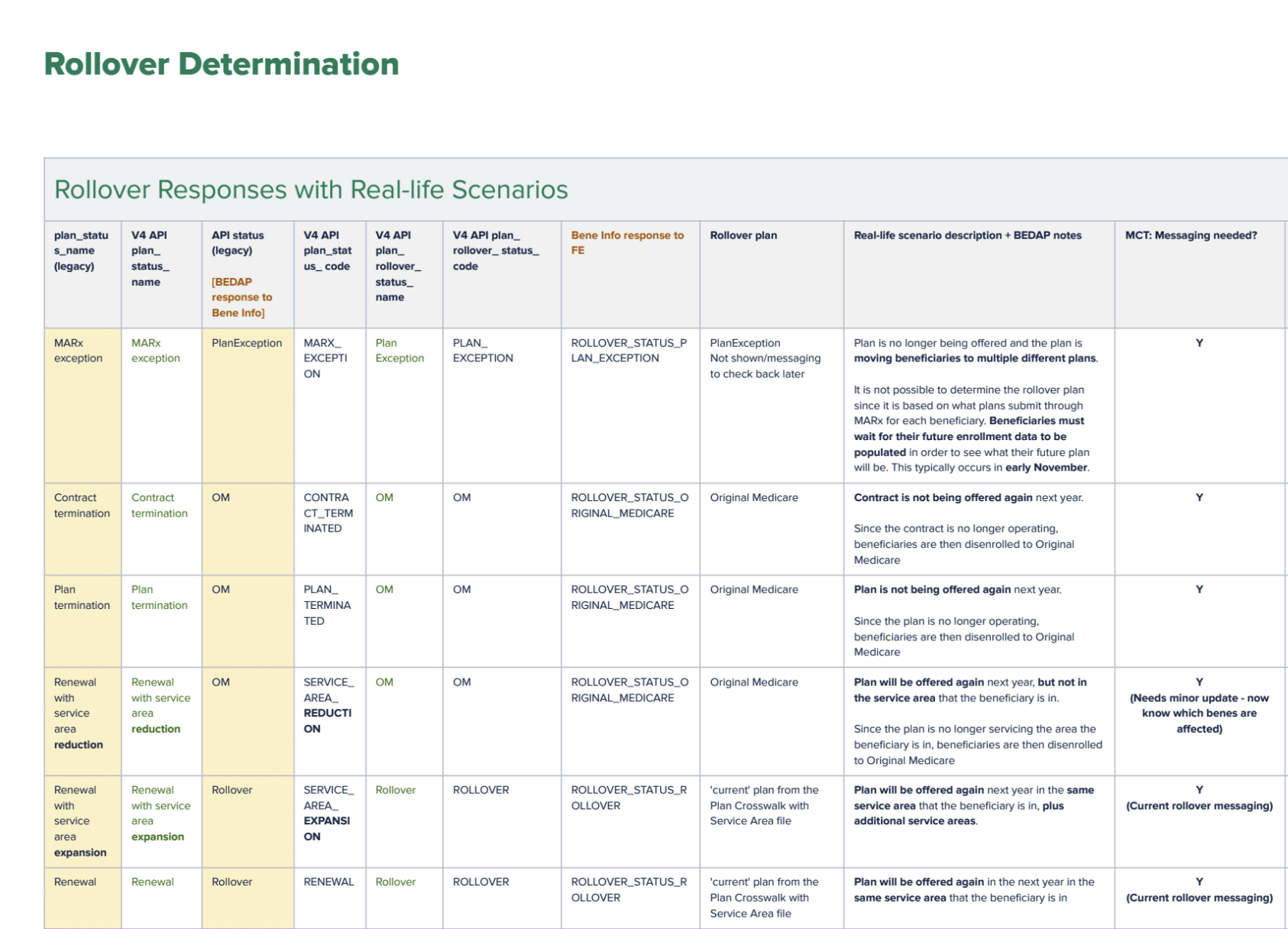
There are 6 rollover scenario categories.
-
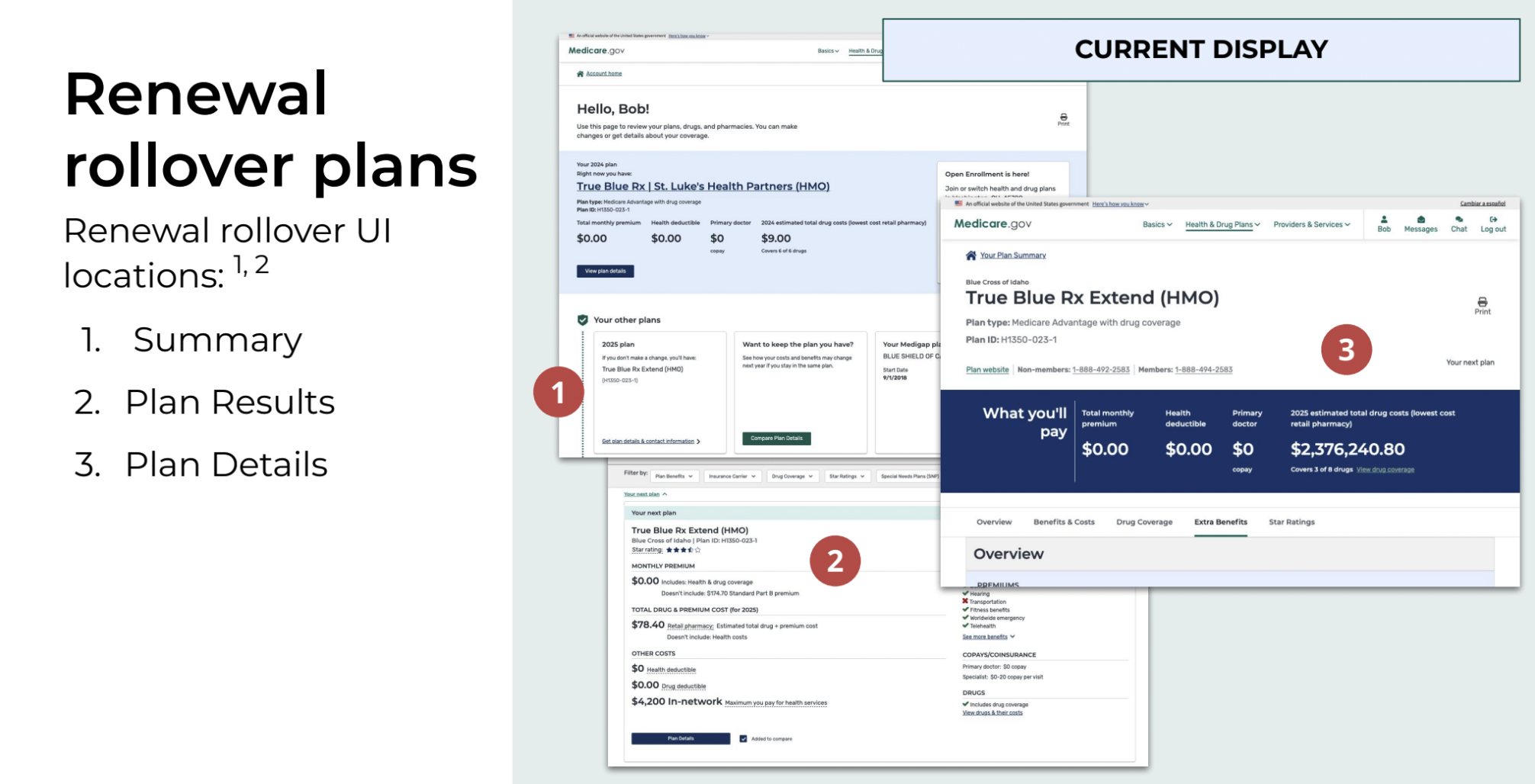
Renewal
- The plan will be offered again next year, in the beneficiary's service area.
- Beneficiaries rollover to the same plan ('current' plan).
- Most crosswalk rollovers fall into this category.
-
Renewal with service area expansion (SAE)
- The plan will be offered again next year, in the beneficiary's service area, plus additional service areas.
- Beneficiaries rollover to the same plan('current' plan).
-
Renewal with service area reduction (SAR)
- The plan will be offered again next year, but not in the beneiciary's service area.
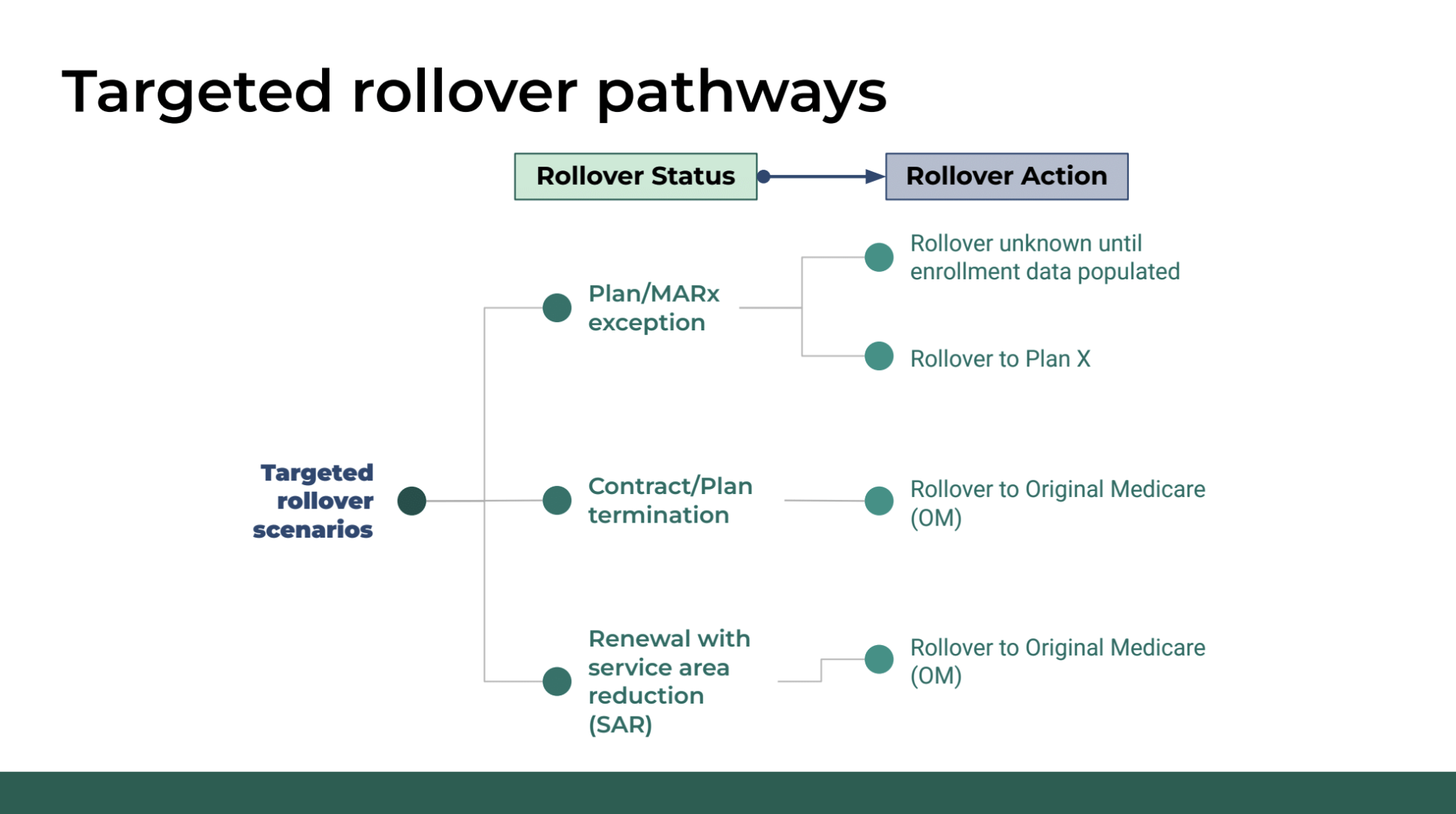
- Beneficiaries are disenrolled to Original Medicare.
-
Disenrolled
- Applies to beneficiaries whose plans have an end date during the current calendar year, so there is an indeterminate rollover at the time of getting the demographic data.
- This scenario can also include beneficiaries who are safely enrolled in another plan.
-
Contract/Plan termination
- Contract/Plan is not being offered again for the next plan year.
- Beneficiaries are disenrolled to Original Medicare.
-
Plan/MARx exception
- The plan is moving beneficiaries to multiple different plans. It's not possible to determine the rollover plan since it's based on what plans submit through MARx for each beneficiary.
- Beneficiaries must wait for their future enrollment data to be populated in order to see what their future plan will be, or contact their current plan. Enrollment data population typically occurs in early November.
-
- Beneficiaries typically receive an Annual Notice of Change (ANOC) or a specific plan termination/crosswalk letter in late September explaining that their current plan is changing and describing the new plan they will be moved into.
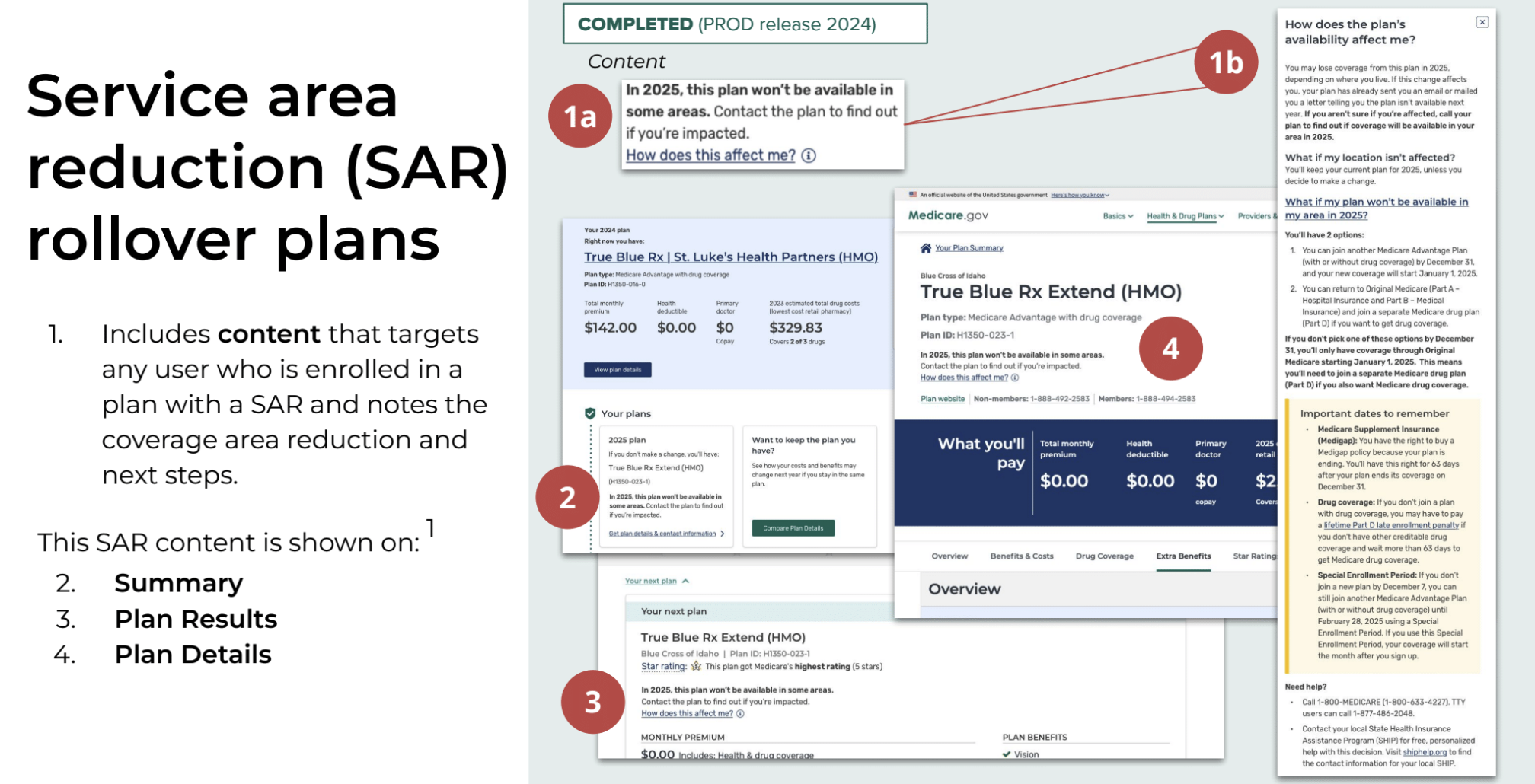
- MPF previously displayed rollover messaging targeted at beneficiaries in a SAR scenario. In addition to the renewal rollover scenarios, this was the only additional rollover scenario that MCT had access to in the data at the time.
-
The disenrolled rollover status category has 23 additional sub-categories or "reason codes" that explain why a person's coverage under a specific plan ended.
-
MCT currently doesn't have access to:
- Knowing if a plan has a disenrolled status for a beneficiary outside of Public Preview and Open Enrollment (OE);
- Specific reason codes from BEDAP datasource tied to the beneficiary data;
- Specific beneficiary next steps to follow after a disenrollment (based on plan communication, tailored to the reason code);
-
Examples of reason codes:
- Disenrollment due to plan-submitted rollover
- Disenrollment because of enrollment in another plan
- Report of death
- Failure to pay premiums
- Confirmed incarceration
-
MCT currently doesn't have access to:
Analytics synthesis
Taking a look at beneficiary plan rollover status.For more insight into how many beneficiaries are affected by certain rollover status', the MCT Beneficiary team took a look at beneficiary data from BEDAP for coverage year 2026. Most beneficiaries fall into the renewal category followed by the broader disenrolled status. While the percentage of beneficiaries that fall into the remaining categories varies from 1% to 3.6%, it was found to still be a significant enough number (millions of enrollees) to warrant prioritization of this project by our CMS stakeholders.
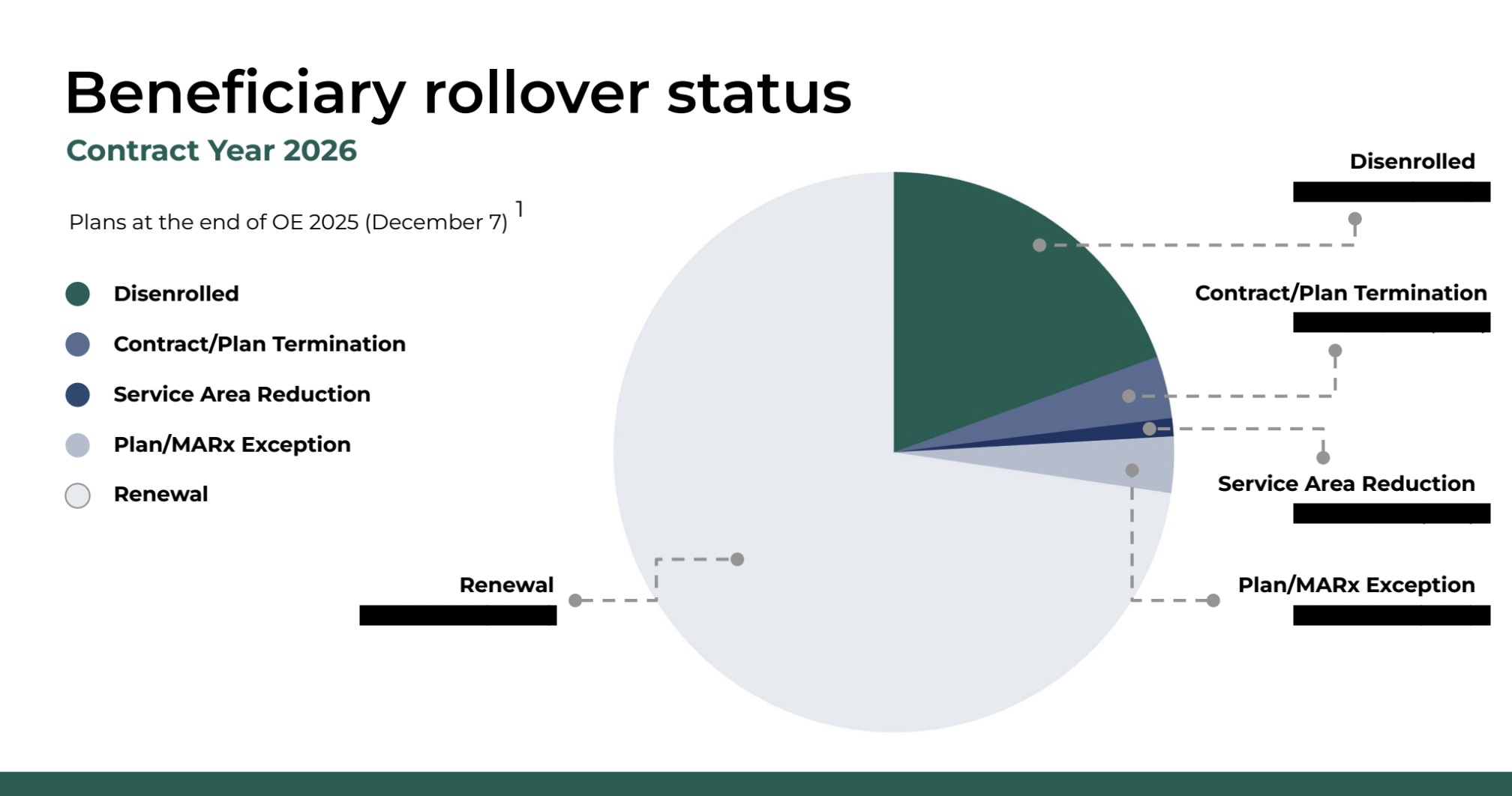
- Some specific plan and enrollment data unable to be disclosed.
Project alignment
Unifying the product vision.Equipped with the information obtained from this discovery and analysis, there was an opportunity for additional stakeholder open discussion and alignment on next steps. This was also a chance for Engineering to get a high-level look at the recommendations and determine if there were any blockers or potential problems with implementation as described.
-
Because MCT lacks additional insight into the current disenrolled rollover status (reason codes, plan communication on next steps, etc.) and is not able to display meaningful disenrollment details to beneficiaries, it was recommended to not display any disenrollment information at this time.
-
Special rollover messaging continues to not be necessary for renewal and renewal with service area expansion rollover scenarios, as the beneficiaries will be remaining with the same plan in the next plan year.
-
Provide tailored rollover messaging targeted at beneficiaries who fall into the 3 remaining rollover scenarios - Plan/MARx exception; Contract/Plan termination; Service area reduction (SAR).
-
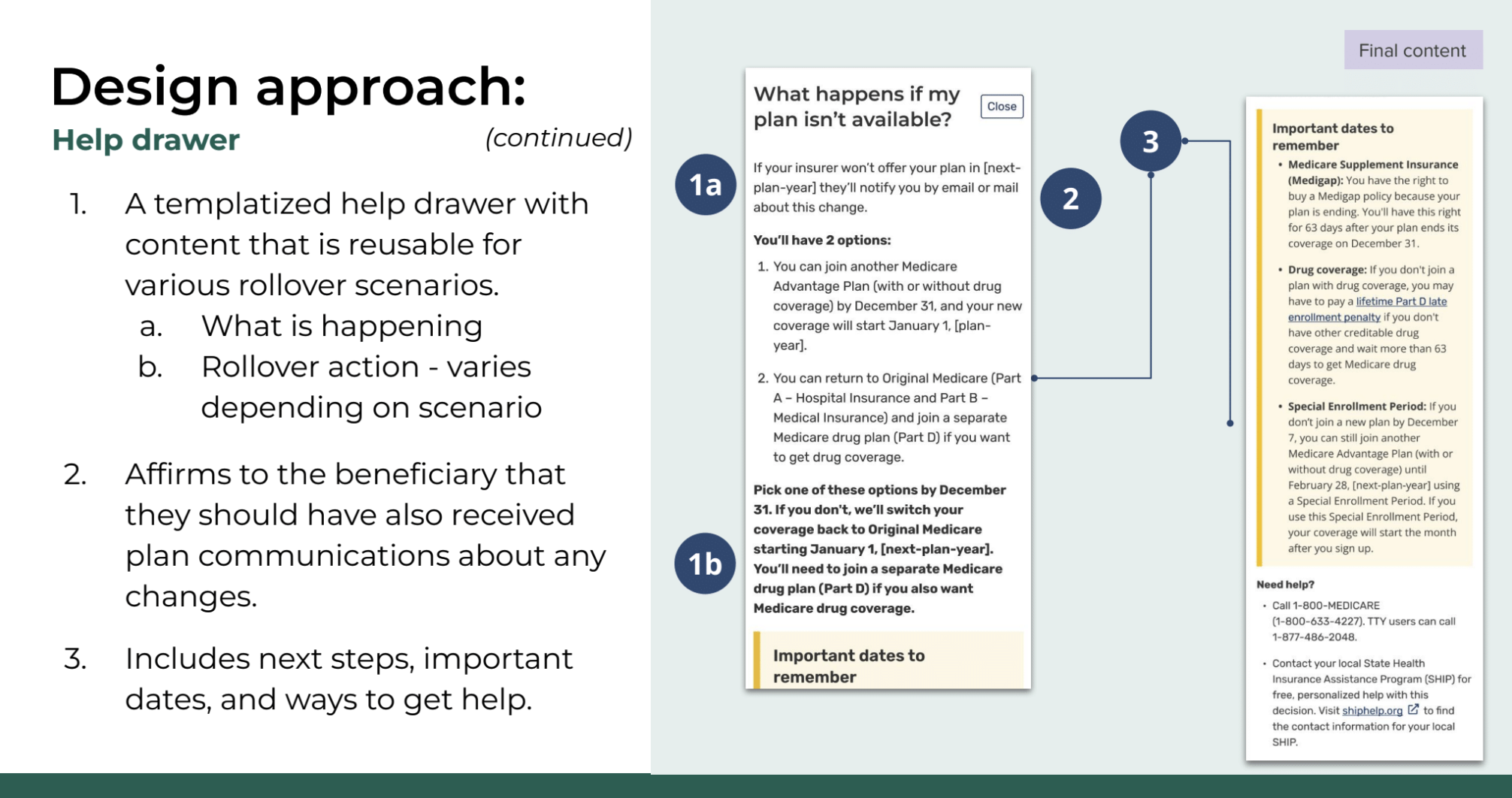
Repurpose our previous Service Area Reduction (SAR) messaging to use for each targeted rollover scenario.
-
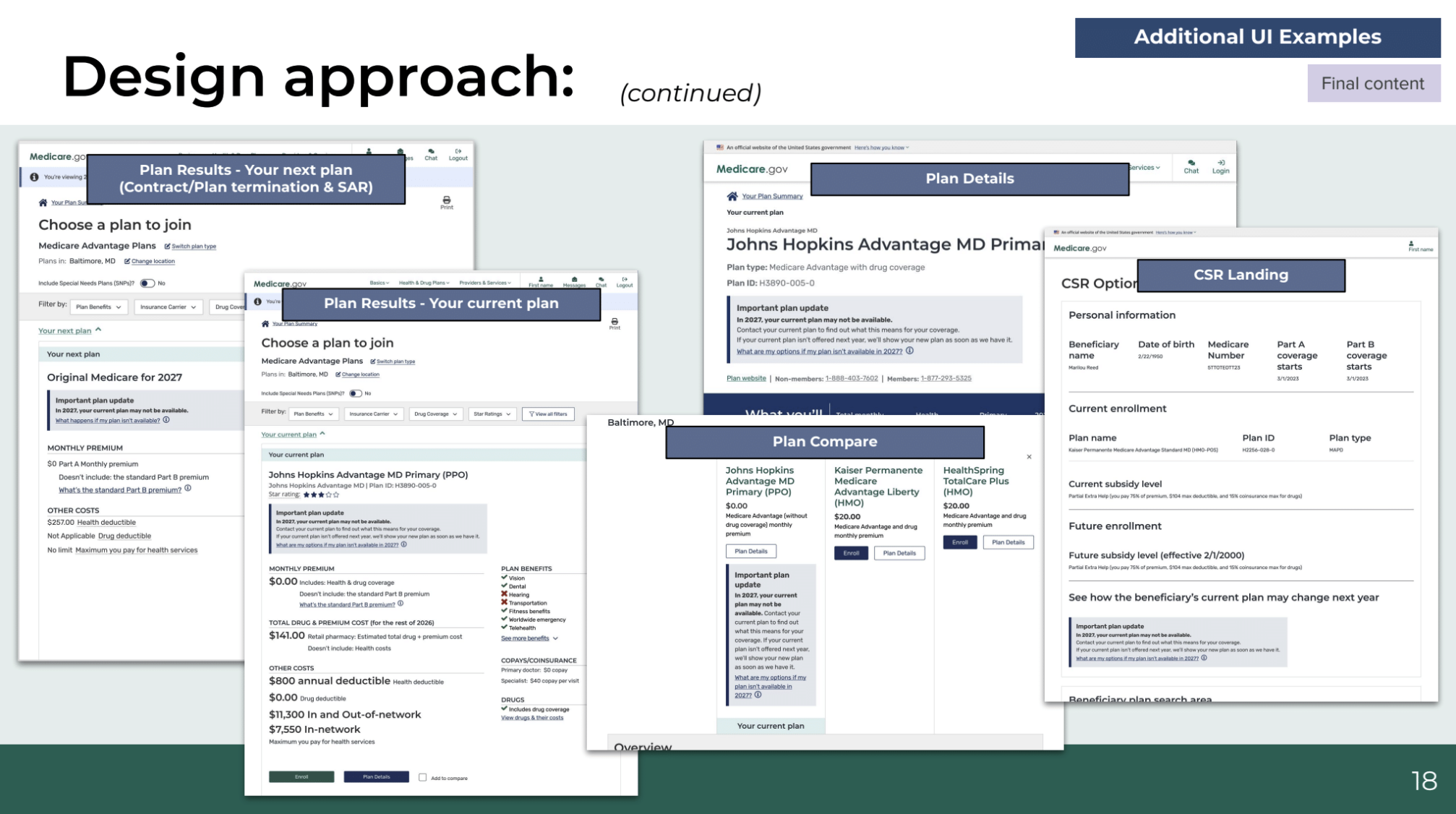
Format messaging across the Medicare Plan Finder (MPF) UI to be interchangeable based on what rollover scenario the beneficiary fits into.
- Make the dynamic content requirements minimal.
-
Tell the beneficiary what is happening and next steps.
-
Affirm that the beneficiary should have also received Plan communications about any changes.
-
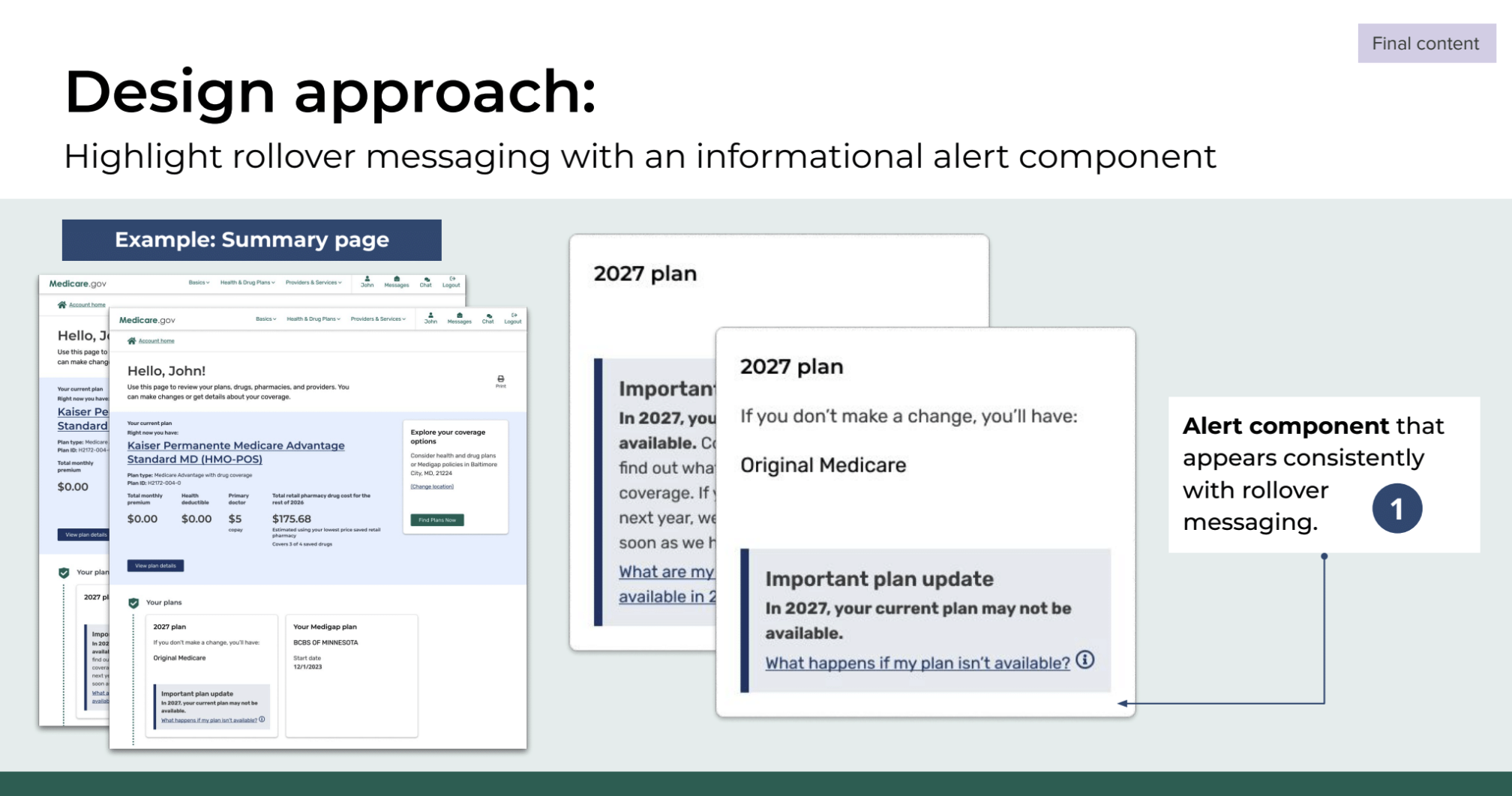
Visually highlight rollover messaging to draw attention to the content.
- Avoid causing alarm or undue concern to the beneficiary about potential plan changes by using a familiar informational alert component.
- Reinforce beneficiary confidence in their upcoming rollover decision.
-
Remove the rollover messaging if the beneficiary makes another plan selection.
:: Stakeholder buy-in, Implementation, & Testing ::
To ensure consensus on moving forward, MCT shared the overall recommendations with broader CMS groups and leadership for approvals. At this time, MCT also began the process of engaging the CMS Content team with a formal content request submission.
The MCT UX team proceeded to go through specific requirements for implementation with the MCT Engineering team in preparation for upcoming sprint work. During this discussion, engineers have the opportunity to think through the solution and ask questions as they arise. There is typically a checklist of items that the teams go through to make sure the work can be completed. For example, ensuring that the engineering team has access to any design files and annotations, making sure that different variations/states have been accounted for, and determining if any feature flags are needed.
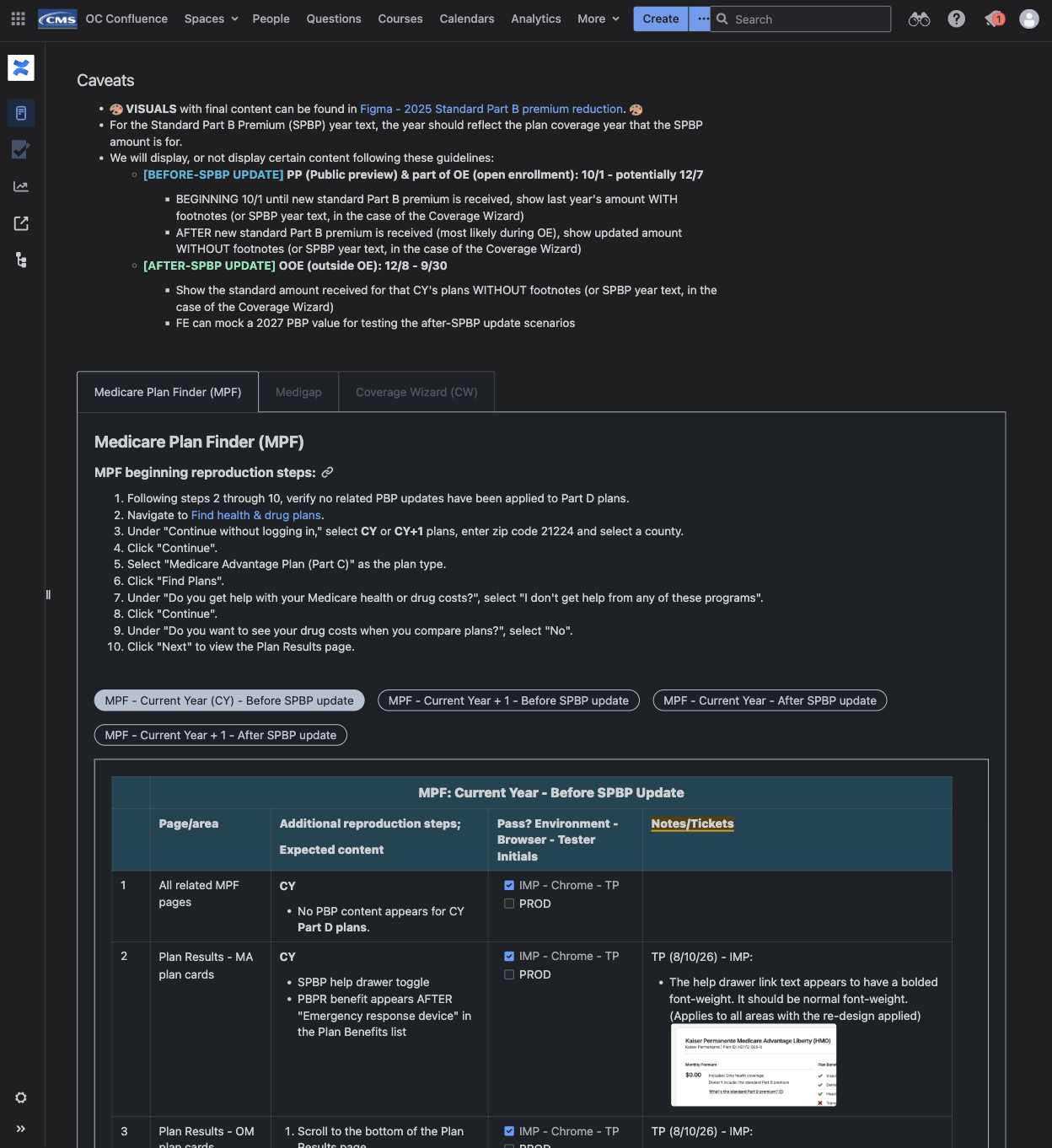
While the Engineering team was preparing to work on this project, a test plan was created capturing each scenario variation that will need to be tested during the QA process post-implementation. Because this work targeted the authenticated experience, there was additional collaboration with our MCT Beneficiary team to work with CMS on the creation and update of synthetic beneficiaries for testing purposes.
:: Post-research analysis ::
A comprehensive overview of post-research synthesis.Ahead of the scheduled release of this work for OE 2026, our CMS Department of Research and their third-party research team conducted 60-minute virtual interviews in June 2026. Participants were shown rollover messaging for each of the 3 targeted rollover scenarios. MCT documented a comprehensive overview of post-research synthesis and recommendations for the future.
Research objectives to gain feedback on:
-
How noticeable was the rollover messaging?
-
How did beneficiaries interpret the rollover messaging?
-
Where might beneficiaries click for additional information?
-
What reactions did beneficiaries have to the Summary and Plan Results pages with rollover messaging present?
UX high-level takeaways
-
Overall, the rollover messaging was seen as important and users appreciated being alerted to a potential change in their plan. They found it enough to seek more information.
-
The rollover messaging was not always noticeable.
- In the Plan/MARx exception scenario, participants lost track of why they landed on Plan Results - "Your next plan" view without the display of rollover messaging for context. In this scenario, the beneficiary’s next plan is unavailable for display until MCT receives their enrollment data from BEDAP.
- The ambiguity of the message left participants unsure of plan availability, but participants expressed they were likely to try to find out more information by clicking on the help drawer link or contacting their plan.
- The difference in meaning between general plan unavailability versus regional plan unavailability wasn't noticed.
- Participants found the Plan/MARx exception messaging vague and confusing.
-
The rollover messaging was not always noticeable.
-
Users found the rollover help drawer content clear and helpfully directive.
- Participants expressed that the differing help drawer link labels between the scenarios led to different expectations on click. The matching labels from the Contract/Plan termination and SAR scenarios set the most accurate expectations for participants - that clicking would yield more detailed information. The help drawer link label for the Plan/MARx exception suggested incorrectly that clicking would yield specific plan options.
- While participants assumed they would need to look for another plan, most did not independently say they would interact with the Find Plans Now workflow button to do so.
- Open Enrollment end-to-end research can serve as an opportunity to look for additional commentary on rollover messaging presented to beneficiaries in these unique scenarios.
Future Considerations
Where do we go from here?-
Reduce user confusion.
- For Contract/Plan termination and SAR scenarios, update the messaging on the user's Summary page to reflect more consistent messaging.
- For the Plan/MARx exception scenario simplify the messaging and transparently explain that plan information is not available at the current time.
-
Be consistent in language and match user expectations.
- Update the help drawer link label for the Plan/MARx exception scenario to match the other rollover scenarios.
-
Provide connecting context.
- For the Plan/MARx exception scenario, even though there is no next plan to display to the beneficiary, include the “Your next plan” card on Plan Results with the repeated note that the plan is not available at the current time. Include the appropriate rollover messaging to provide orienting context.
-
Provide an actionable, immediate next step.
- Explore a way for users to begin the process of searching for another plan as an immediate next step within Medicare Plan Finder.
-
Gather more feedback for future iterations.
- Use Open Enrollment end-to-end research as an opportunity to look for additional commentary on the rollover messaging presented to beneficiaries in these unique scenarios.
-
Consider iterating on the visual presentation of the rollover messaging to emphasize the content and presence more.
- Watch Open Enrollment end-to-end research as the rollover messaging will be presented in an updated Medicare site redesign format.
-
Re-evaluate the inclusion of ambiguous content, and instead provide beneficiaries with more definitive language about their plan.
- Work with our partners at HPMS and plans to know definitively if a plan will or will not be available ahead of presenting any rollover messaging to users.
-
Disenrolled rollover status updates:
- Collaborate with BEDAP to submit needed data to MCT.
- Gain access to current plan communications to beneficiaries based on their related reason code category.
- Display tailored disenrolled rollover messaging during any time of the year that a beneficiary may become disenrolled, filtering out this display for beneficiaries who are safely enrolled in another plan.
- Include guiding next steps for beneficiaries to follow after a potential disenrollment. Reaffirm plan communications that the beneficiary has already received.